• Posted on

Why Handcrafted Accessories Cost More

Why Handcrafted Accessories Cost More

Table of Contents

Last Updated: October 20, 2026

The Real Cost of Handcrafted Accessories

When you hold a handcrafted accessory, you're holding hours of intentional work. A beaded coin purse isn't just a container for loose change, it's the result of someone placing each bead by hand and selecting quality materials.

You Are Amazing Beaded Coin Purse - 100% Handmade Beaded Coin Purse You Are Amazing Beaded Pouch

At Mercury & Bloom, we curate handmade pieces because the price reflects real value: time, skill, materials, and care.

This guide breaks down the real economics of handcrafted accessories, from labor and materials to quality control and longevity.

Handmade vs Mass-Produced Accessories: Where the Price Gap Comes From

A handmade beaded tote might cost $209, while a factory-made bag with similar dimensions costs a fraction of that, because the two production methods operate on completely different economics.

Beaded Mahjong Tote (Ivory/Multi/Fuchsia)

Mass production relies on automation, standardization, and volume.

Handcrafted production doesn't scale that way. Each piece requires direct human effort from start to finish, and automating the beading or hand-stitching would destroy what makes handmade items valuable.

Materials tell part of the story too. Mass producers buy in bulk at commodity prices, often choosing the cheapest options that meet minimum standards.

Labor, Time, and Skilled Craftsmanship

Skilled craftsmanship is the largest cost component in any handcrafted accessory, and the hardest to quantify.
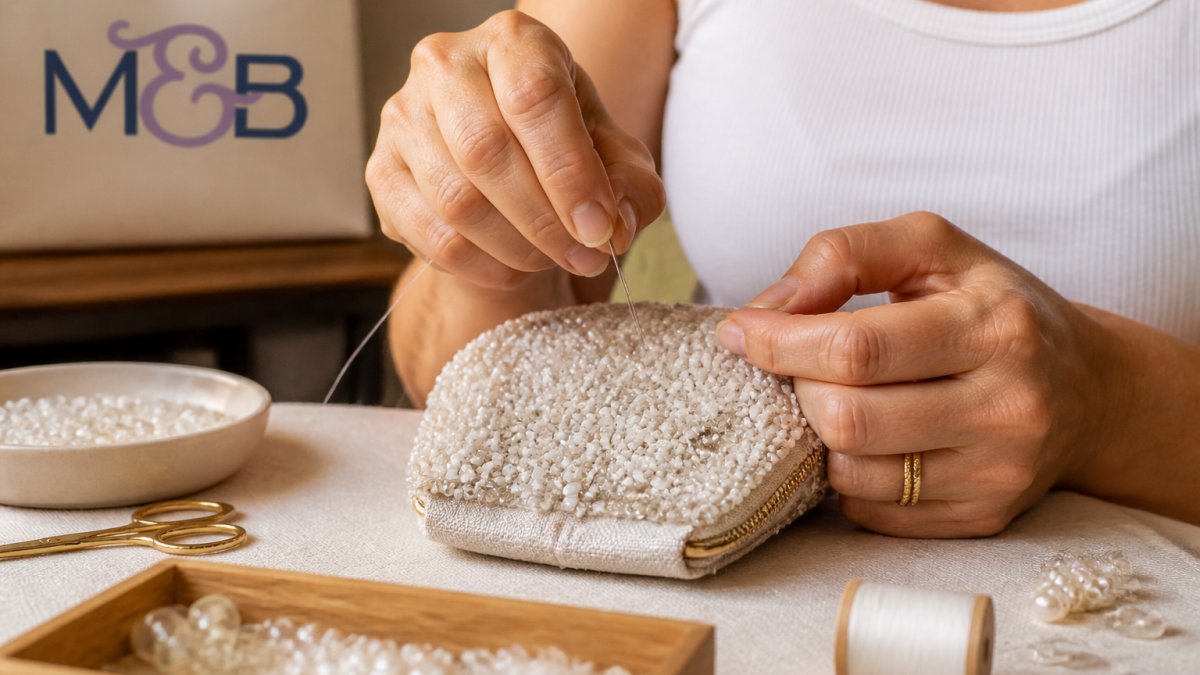
Close-up process diagram showing the meticulous needlework required to attach beads to a handmade coin purse.

Consider a handmade beaded coin purse. The maker places each bead individually, which takes hours per piece.

Peach Bow Ribbon Beaded Coin Pouch

Skill matters too. An experienced beader works faster than a beginner, but more importantly makes better decisions about design, color placement, and structural integrity.

Time is the constraint that makes handcrafted production fundamentally different from factory work.

Material Quality and Ethical Sourcing

The materials in a handcrafted accessory are typically chosen for quality first and cost second, reversing mass production's priority.

A handmade bag might use high-quality cotton that costs more per yard but softens with use rather than pilling.

Ethical sourcing also increases costs. Materials from suppliers who pay fair wages or use sustainable practices cost more than the cheapest available source.

The supply chain for handcrafted accessories is typically shorter and more transparent than for mass-produced goods.

How to Price Handmade Items: What Makers Consider

Most articles about handmade pricing stay at "labor plus materials plus overhead." That's true but not useful. The clearer way to see why handcrafted accessories cost more is an itemized breakdown of where each dollar goes. The numbers below are illustrative of a common pattern among small-batch makers, but the structure is what matters.

An itemized example: a beaded coin purse

Take a hand-beaded coin purse. A small-batch maker might break the price down roughly like this:

  • Materials: $7-$10. Glass or seed beads, beading thread, cotton or linen shell fabric, a metal zipper, lining fabric, and pom-pom or tassel trim. Higher-grade beads and solid brass hardware push this toward the top of the range.
  • Direct labor: $18-$24. At three to four hours per piece and an internal rate of $6-$8 per hour for bench time, labor is the single largest line. Many makers underpay themselves here, which is why the retail price often looks high to a buyer but still leaves the maker with a thin margin.
  • Tools and equipment amortization: $1-$2. Beading needles, a sturdy frame or hoop, lighting, a sewing machine for the lining, and small hand tools wear out. Spread across a year's production, this is a real per-unit cost.

Two things stand out. Labor is not a rounding error, it is the price. And the "profit" line is usually thinner than buyers assume, which is why handmade prices are a cost-recovery exercise.

Why the same accessory can be priced very differently

Two makers can list nearly identical coin purses at $32 and $65, and both can be honest. The difference comes from four levers:

  1. Material grade. Seed beads versus glass beads, cotton versus linen, plastic versus metal zipper teeth. A materials swing of $3-$5 per unit is common and compounds at retail.
  2. Construction time. Hand-stitched lining versus machine-sewn, individually placed beads versus a beading loom. Time differences of an hour or more per piece are normal.
  3. Production scale. A maker producing 20 pieces a month carries the same studio overhead as one producing 200, so the per-unit overhead is ten times higher.
  4. Channel. Direct-to-buyer pricing can be lower than wholesale or consignment pricing for the same item, because the maker isn't splitting the retail price with a retailer.
Pro Tip When a handmade price looks high, ask which of the four levers is doing the work. A high price driven by material grade and construction time is a different value proposition than a high price driven by a retail channel.

The costs buyers don't see

A few line items rarely appear in a pricing formula but still shape the retail price:

  • Design and prototyping time. The first version of a new accessory is usually not sellable. Makers absorb the cost of failed prototypes, reworked patterns, and rejected colorways.
  • Waste and seconds. Beads break, thread tangles, and some finished pieces don't meet the maker's standard. That failure rate is built into the price of the pieces that do sell.
  • Photography, listings, and customer service. For a direct-selling maker, these are real hours that don't produce inventory but are required to sell it.

None of these are unique to accessories, but they hit small-batch makers harder because unit volumes are low and per-piece labor is high. That is the structural reason a handcrafted accessory costs more: the price is mostly a labor and materials story.

Shop Now →

Understanding Handmade Jewelry Value

Handmade jewelry sits at an intersection of craftsmanship, materials, and personal investment, and its value proposition differs because jewelry often carries emotional significance.

A handcrafted piece of jewelry typically costs more than a mass-produced equivalent because of the time invested in design and creation.

Uniqueness affects pricing too.

Quality control matters more in jewelry because the consequences of failure are higher.

Assessing Quality and Long-Term Value

The real measure of whether a handcrafted accessory is worth its price isn't the initial cost, it's the cost per wear over its lifetime, plus what it costs to keep it in service. That requires two skills: inspecting for genuine construction quality, and doing the long-term math fairly.

How to inspect an accessory before you buy

Quality shows up in specific, checkable details. The exact checks differ by accessory type.

Jewelry

  • Clasps and findings. Look for solid metal rather than hollow or plated pot metal. A lobster clasp should spring back crisply; a jump ring should be soldered closed, not just bent shut.
  • Connections. On beaded or linked pieces, tug gently at the joins. Loose crimps, exposed thread, or gaps at the jump rings predict early failure.
  • Finishes. On metal pieces, check the back and the edges, not just the face. Rough edges, uneven plating, or solder blobs on the reverse side are signs of rushed finishing.

Bags and totes

  • Stitching. Look for small, even stitches with no long skipped runs. On a quality bag, stress points like handle attachments and the top of the zipper are reinforced with a box-X stitch or a double row.
  • Seam finish. Turn the bag inside out if you can. Raw, fraying seam allowances are a warning; bound or finished seams last longer.
  • Hardware. Zippers should run smoothly without catching. Metal feet on the base protect the fabric and signal a maker thinking about wear.

Belts

  • Leather or fabric quality. Full-grain or top-grain leather develops patina and resists cracking; bonded or corrected-grain leather often peels at the edges over time.
  • Edge finishing. Burnished, painted, or stitched edges last longer than raw cut edges.
  • Buckle and holes. A solid buckle and cleanly punched holes that don't tear are signs of care. Check that the buckle prong aligns with the holes without strain.

Hair accessories

  • Clips and closures. Spring tension should be firm, and the clip should be attached with more than glue. Look for rivets, screws, or stitched attachment points.
  • Covering and finish. Fabric or leather covering should be smoothly wrapped with no exposed raw edges at the tips, where wear concentrates.
  • Weight and balance. A well-made clip sits balanced and doesn't pull; a heavy decoration on a flimsy clip will fail at the attachment point.
Watch Out Small irregularities are normal in handcrafted work and often add character. The line to watch is structural: uneven stitching is cosmetic, but a loose clasp, a raw stress-point seam, or a glued-on closure is a durability risk.

Comparing prices fairly across makers

To compare prices fairly, normalize on four variables:

  1. Material grade. Note the specific materials, not just the category. "Glass beads" and "seed beads" are different inputs with different costs and lifespans.
  2. Construction time and method. Hand-stitched versus machine-sewn, individually placed versus loomed. Ask if it isn't stated.
  3. Production scale. A one-person studio and a small factory can both be "handmade," but their overhead per unit differs sharply.
  4. Expected lifespan and repairability. A piece designed to be repaired and a piece designed to be replaced are not priced on the same curve, even at the same sticker price.

A useful habit is to ask the maker two questions: what is the piece made of, specifically, and can it be repaired if a component fails? The answers usually explain the price gap faster than any general claim about craftsmanship.

Cost per wear, with the repair line included

Cost per wear is simple arithmetic: price divided by the number of wears. The mistake is leaving out repairs and replacements.

  • A $22 handcrafted coin purse used daily for five years is about 1,825 wears, or roughly $0.01 per wear, before any repair.
  • A $5 mass-produced alternative that lasts six months of daily use is about 180 wears, or roughly $0.03 per wear, and then you buy another.
  • If the handcrafted piece needs one $10 repair over those five years, the effective cost is about $32 over 1,825 wears, still roughly $0.02 per wear.

The handcrafted option is cheaper over time even after a repair, because the denominator, the number of wears, is much larger. That is the whole long-term value argument in one calculation.

Care and repairability: the part buyers forget

Durability claims are only concrete if you know how to maintain the item and whether it can be fixed.

  • Jewelry. Store pieces separately to avoid scratches, keep beaded and plated items away from perfume and moisture, and have a jeweler re-tighten settings or replace a clasp before it fails.
  • Bags. Wipe hardware dry, condition leather periodically, and have a cobbler or the maker restitch a handle before the seam opens further.
  • Belts. Rotate belts, hang rather than coil them, and condition leather to prevent cracking at the fold.
  • Hair accessories. Avoid leaving clips in damp hair, and check attachment points periodically for looseness.

A maker who offers repairs, replacement parts, or care instructions is signaling that the item was built to be kept. That signal is often worth more than any single material upgrade.

When Mercury & Bloom curates handcrafted accessories, we're selecting pieces built on this principle: items designed to be kept and used for years, not discarded after a season. The You Are Amazing Beaded Coin Purse exemplifies this approach, handcrafted with quality cotton and individually placed beads, it's built to become more beautiful with use, not wear out.

Frequently Asked Questions

Why do handcrafted accessories cost more than mass-produced ones?

Handcrafted accessories carry higher prices because they involve skilled labor, quality materials, and small-batch production. Each piece requires hours of hands-on work, often from experienced artisans who command fair compensation for their expertise. Mass-produced accessories use factory machinery, cheaper materials, and economies of scale that handmade creators simply cannot match. You're paying for uniqueness, durability, and the maker's time and skill.

How do makers calculate the price of a handmade accessory?

Makers typically calculate handmade prices by adding material costs, labor hours (hourly rate × time spent), overhead (workspace, tools, supplies), and a profit margin. The formula is: (Materials + Labor + Overhead) × Markup. Transparent makers break this down so customers understand what they're paying for.

Are handcrafted accessories worth the higher price?

Yes, if durability and uniqueness matter to you. Handcrafted pieces use quality materials and construction that last years longer than mass-produced alternatives. A hand-beaded accessory won't fray or break as easily, and the time-intensive craftsmanship means better finishing and attention to detail. Cost per wear often favors handmade items because they're worn longer and repaired more easily. If you value one-of-a-kind design and sustainability, the investment pays off.

What should I look for when buying handcrafted accessories?

Check for even stitching, secure hardware, quality materials, and consistent finishing. Ask the maker about their process, materials sourcing, and whether items are customizable. Reputable handmade makers provide detailed product photos, clear descriptions of construction methods, and transparent pricing breakdowns. Look for makers who address uniqueness, handmade items should have natural variations, not factory-perfect uniformity. Verify return policies and quality guarantees before purchasing.

Read Also

See all News
Best Sustainable Home Decor Brands 2026
  • Posted on
Best Sustainable Home Decor Brands 2026
Discover the best sustainable home decor brands for 2026. Shop handmade, eco-friendly pieces with ethical sourcing and natural materials.
7 Creative Mahjong Party Favors for Guests
  • Posted on
7 Creative Mahjong Party Favors for Guests
Seven creative mahjong party favors for guests, from beaded pouches to custom card sleeves, with prices and packaging tips for your next game night.
Best Functional Pouches for Parenting Needs
  • Posted on
Best Functional Pouches for Parenting Needs
Find the best functional pouches for parenting. Compare stylish, durable options designed for daily essentials, organization, and on-the-go convenience.
What Makes Handcrafted Goods Worth It
  • Posted on
What Makes Handcrafted Goods Worth It
Handcrafted goods worth: Discover why handcrafted goods cost more and deliver real value. Learn quality markers, sustainability impact, and cost-per-use.