Your cart is empty
Tax included and shipping calculated at checkout

Drawer menu
Tax included and shipping calculated at checkout

Last Updated: September 25, 2026
Most people wear the wrong shoe size, a common estimate in footwear fitting is that a large share of adults are at least a half size off, which explains the blisters, heel slippage, and unworn sneakers in the back of the closet. This guide from Mercury & Bloom breaks down custom sneaker sizing the way a fitter would: measure first, convert carefully, then account for what size charts ignore.
Measuring your foot correctly takes about ten minutes and a few household items. Measure both feet, standing, late in the day.
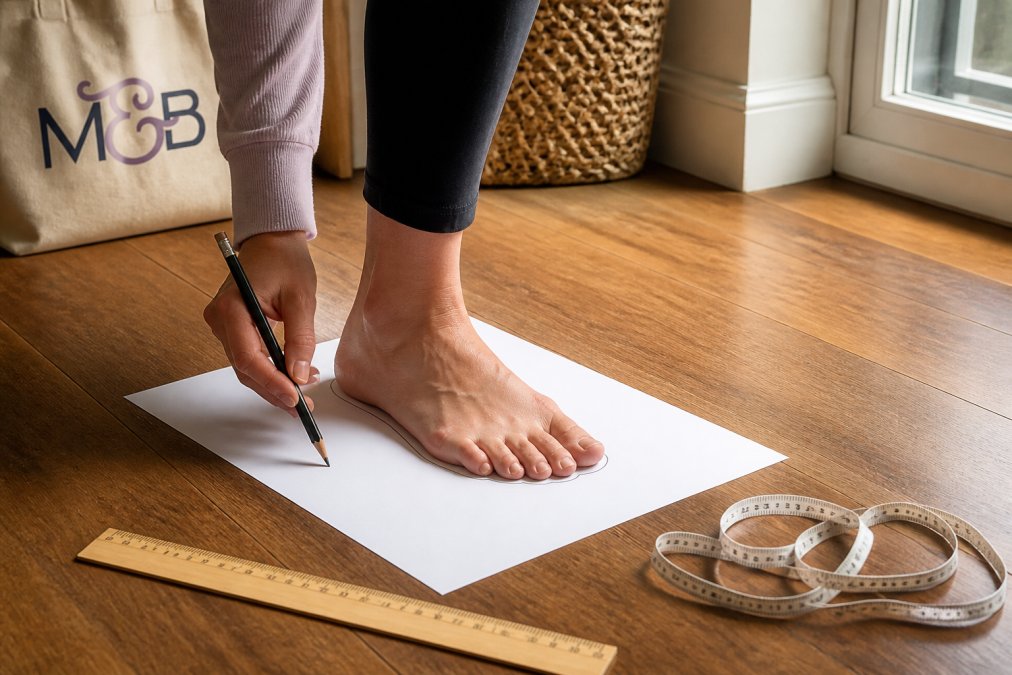
Gather these before you start:
Measure in the afternoon or evening: feet swell through the day, so a morning measurement runs short. Never measure seated, your foot spreads under body weight, and that spread is what you're capturing.
Follow this measurement protocol for each foot separately:
Record every number in centimeters. Most international conversion charts are metric, and rounding in inches introduces a half-size discrepancy or more.
Width is where standard sizing fails most people: two feet of identical length can differ by a full width grade, yet most sneakers come in a single medium width. Volume and arch height also determine whether a correctly wide shoe actually fits.
Standard width sizing uses letter grades, with "D" the common medium for men and "B" for women, but a single medium width is built around an average foot few people actually have.
| Fit Factor | Standard Sizing | Custom Sizing |
|---|---|---|
| Length | Single labeled size | Measured in centimeters |
| Width | One medium width | Matched to your width grade |
| Volume | Average foot volume | Adjusted for instep height |
| Arch support | Generic footbed | Shaped to your arch profile |
| Toe box clearance | Fixed | Sized to your toe spread |
Foot volume describes how much vertical space your foot occupies, the variable most sizing guides ignore. A high-volume foot in a low-volume sneaker feels tight across the instep even when length and width are perfect. If laces dig into the top of your foot, volume is usually the culprit.
To estimate your volume, measure your instep height:
Arch height affects how your foot sits in the shoe and where pressure lands, a core measurement for custom and bespoke footwear that most guides skip.
A simple at-home method is the wet-foot test:
Material behavior turns a good initial fit into a bad long-term one, or vice versa.
A conversion chart translates your measured foot length into regional labeled sizes. Always start from your centimeter measurement, never a size you "usually wear."
| Foot Length (cm) | US | UK | EU |
|---|---|---|---|
| 22.5 | 5 | 3 | 35.5 |
| 24.0 | 6.5 | 4.5 | 37.5 |
| 25.5 | 8 | 6.5 | 40 |
| 27.0 | 9.5 | 8 | 42.5 |
| 28.5 | 11 | 9.5 | 45 |
Fit is the foundation of styling, but statement sneakers usually look off because of how the shoe's volume and last interact with the silhouette, not the outfit. This section reframes styling through a fit lens.
A sneaker a half size too long gaps at the toe and pushes the heel forward, making it look clunky. Too narrow across the ball forces the upper to bulge at the sides, distorting the silhouette. Too much volume under the laces creates a puffy look no outfit can rescue.
Once fit is correct, styling is a proportion exercise: the sneaker's visual weight should match the hem above it.
If a statement sneaker feels tight across the instep but the length is correct, the issue is volume, not size. Try a thinner sock or a different lacing pattern before sizing up, which would only add unwanted length.
At Mercury & Bloom, our handcrafted pieces are chosen with the understanding that individuality and style only work when the fit underneath is right.
| Mistake | Why It Happens | The Fix |
|---|---|---|
| Measuring seated | Foot doesn't spread under weight | Measure standing |
| Using inches only | Rounding creates a half-size gap | Measure in centimeters |
| Sizing to smaller foot | Assumes feet are identical | Size to the larger foot |
| Ignoring volume | Length gets all the attention | Check instep and arch height |
| Sizing up for width | Width can't be fixed by length | Choose the correct width grade |
| Measuring in the morning | Feet haven't swelled yet | Measure late in the day |
| Trusting the label alone | Every last differs by brand | Confirm against brand fit notes |
Standard sizing is faster and cheaper; bespoke costs more and takes longer but accounts for the width, volume, and arch variables standardized sizing ignores. If you've returned more than one pair for fit reasons, the measurement approach is worth the extra step.
For custom sneakers, always size up rather than down if you are between sizes. Handcrafted footwear often has less stretch than mass-produced pairs, and a snug fit can cause pressure points. Aim for about 0.5 cm (roughly a finger's width) of space at the toe box. If you have wide feet or high arches, sizing up gives your midfoot room to breathe without heel slippage.
Stand on a piece of paper against a wall, heel touching the wall. Mark the tip of your longest toe and measure the distance in centimeters. Repeat for both feet and use the larger measurement. Measure in the late afternoon when feet are slightly swollen, since this reflects your true size. For width, measure across the widest part of your foot. Always use centimeters for the most accurate custom sneaker sizing.
Yes. Custom and handcrafted sneakers are often built on unique shoe lasts, meaning the fit can vary from standard sizing. The upper material also matters: leather may stretch slightly, while canvas holds its shape. This is why a sneaker width guide and accurate foot volume measurements matter more for custom pairs. Always share your exact measurements with the maker rather than relying on your usual size.
A properly fitted sneaker should have about 1 to 1.5 cm (roughly a thumb's width) of space between your longest toe and the front of the shoe. This toe box clearance prevents blisters and pressure points during walking or running. If your toes touch the front when standing, the sneaker is too small. For custom sneakers, confirm the toe box depth with the maker, since handcrafted lasts vary.
Foot width is just as important as length. A shoe that is the right length but too narrow causes midfoot pressure and heel slippage. Standard sneakers come in narrow, medium, wide, and extra-wide, but custom footwear can be built to your exact width. Measure across the widest part of your foot in centimeters and compare it to a size conversion chart before ordering custom sneakers.
Handcrafted sneakers are made on individual shoe lasts, so sizing can vary slightly between makers. Ask for the brand's specific measurement protocol and provide your foot length, width, and arch height. Material matters too: leather uppers may soften and stretch, while suede holds firm. If you are between sizes, go with the larger one and consider an insole for a snug fit.
Getting the fit right is the hard part of buying sneakers online, and it's the part most shoppers skip until a return forces the issue. Mercury & Bloom curates handcrafted, statement-making pieces with a focus on quality, beauty, and functionality, so your footwear reflects your individuality instead of fighting it. Explore the collection to find pieces selected with intention, then add to cart with measurements in hand and confidence in your fit.


