Your cart is empty
Tax included and shipping calculated at checkout

Drawer menu
Tax included and shipping calculated at checkout

Last Updated: October 13, 2026
The difference between a chaotic Mahjong night and a smooth one usually comes down to preparation, not luck.
Mahjong accessories are the supporting tools that make in-person play easier: tile racks, pushers, mats, card holders, scorecards, and storage.
Below, we break down exactly what to buy first, what can wait, and how to match your kit to your group size and the variant you play.
| Accessory | Purpose | Best For | Price Range |
|---|---|---|---|
| Card sleeve | Protects the yearly card | Every social player | Under $20 |
| Tile racks and pushers | Keep hands hidden and organized | Groups of 3-4 | Mid-range |
| Mahjong mat | Cushions tiles and reduces noise | Hosts, long sessions | Mid-range |
| Scorecards | Tracks rounds and payments | League and regular play | Low |
| Storage bag or case | Keeps the set together | Travel and storage | Low to mid |
| Beaded gifts | Thank-you and hostess gifts | Gift givers | $15-$35 |
A common mistake is buying decorative items before the practical ones. Start with protection and organization, then add the fun pieces.
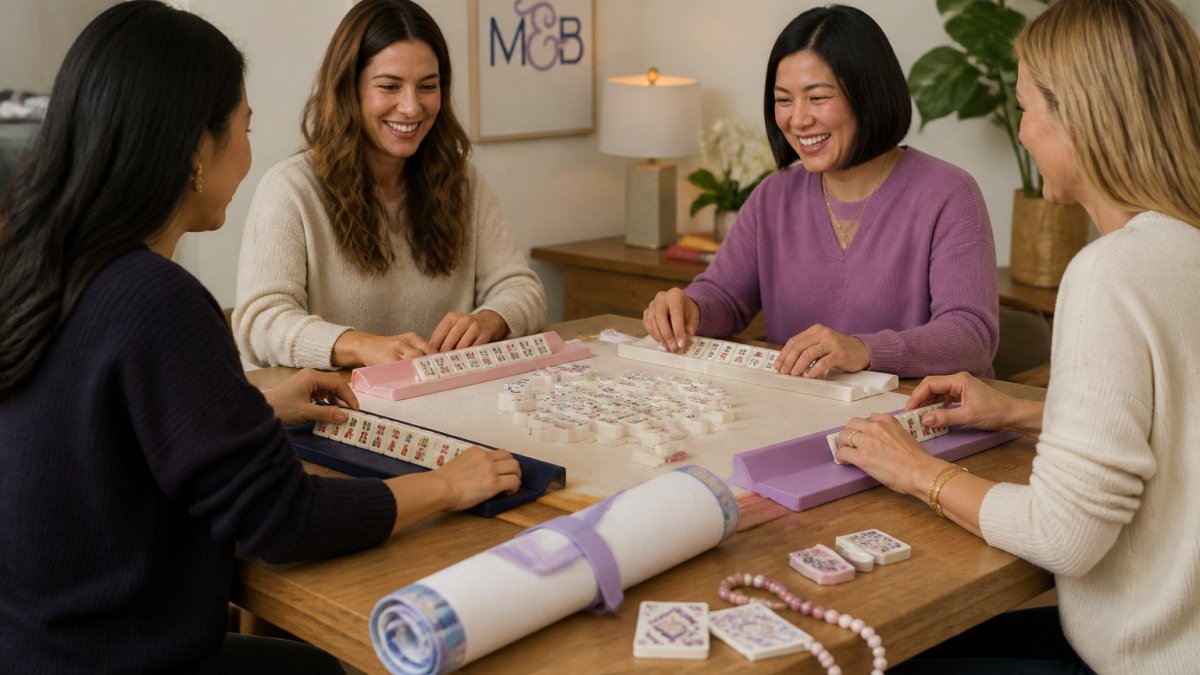
Every social player needs three things: a protected card, a way to hold tiles, and a surface that keeps them from sliding. These are the true mahjong essentials, and they matter more than any decorative add-on.
The yearly Mahjong card is the heart of American Mahjong. It changes every year, and replacing a worn or bent card is annoying. A clear, tri-fold sleeve keeps the card flat and readable for the whole season.
Our Custom Monogram Mahjong Card Sleeve is made to coordinate with the size of the National Mah Jongg League card, in large or standard.
A mat defines the play area and softens the click of tiles. Racks hold your hand upright so opponents cannot see it, and pushers help you move tiles forward without reaching across the table. For groups of three or four, two racks per player is standard.
Mahjong racks are the plastic or wooden stands that hold each player's tiles upright during a hand. They are not glamorous, but they are the difference between a tidy table and a pile of fallen tiles. The details below are what separate a rack that survives weekly play from one that cracks by mid-season.
A social-play checklist organized by game-night role keeps the table from descending into a search for missing pieces:
Organization extends beyond the racks. A shallow tray or bowl for discarded tiles keeps the center clear. A small dish for the dice and wind markers prevents them from rolling under the mat. A dedicated spot for the current discard pile, often a shallow square tray, stops tiles from drifting into another player's space. These small habits keep the game moving and reduce the 'whose tile is that' interruptions that slow a social night.
Most sets include four racks, which works for a four-player table. If you host often, keeping a spare set on hand can be useful. Check the tile grooves periodically, if tiles start leaning or sliding, the rack may be worn. Store racks flat rather than stacked under heavy items, as pressure can warp plastic over time.
Mahjong scorecards track who won each hand and what is owed, which matters most in league play or any group that plays for stakes.
For regular groups, printed scorecards can be a good option.
If your group plays weekly, assign one person as scorekeeper for the night. Rotating the job keeps it fair and stops one player from carrying the whole record.
Mahjong gifts for players work best when they are useful and personal. A beaded pouch or keychain gets used every week, unlike a trinket that sits in a drawer.
For the person who hosts every week, a bigger gesture fits. The Beaded Mahjong Tote at $209.00 is 100% handmade and hand-beaded with a satin lining. The Mahjong Queen Beaded Coin Pouch at $20.00 is a lighter option. For the bar cart, the BAM Bird Acrylic Wine Glass at $28.00 brings a little Mahjong style to the table.


Choose accessories by matching them to your variant, your group size, and how often you play. Most buying mistakes come from treating all Mahjong the same, the equipment overlaps, but the priorities shift depending on which style your group actually plays.
The practical rule: buy the accessories that match the variant your group plays most often, then add cross-compatible items like mats, storage, and scorecards that work regardless of style.
Group size drives quantity, but it also drives logistics:
If you travel to play, prioritize a sturdy case and a rolled mat over bulky items. A wrist-strap bag like the Mahjong Tile Bag at $19.00 keeps small pieces together on the go. Rolled mats may transport better than folded ones, which can develop creases. If your group rotates homes, agree on who transports the mat and who brings the racks so nothing is duplicated or forgotten.
Social play often runs for hours, and comfort matters more than most gift-focused guides admit:
A prioritized approach prevents redundant buying:
For the home bar or table, the Club Mahjong trinket tray insert set at $12.00 adds a decorative touch that swaps with the season, but it is a nice-to-have, not a must-have.
Building a Mahjong kit can feel overwhelming when every store shows a different mix of racks, mats, and charms. Start with the practical layer, a card sleeve, racks, pushers, and a mat, then add storage and gifts once the basics are covered. Mercury & Bloom curates handcrafted, functional pieces that fit that plan, from the custom monogram card sleeve to the hand-beaded tote.
At minimum you need a Mahjong set with 160 tiles, a Mahjong card, and tile racks for each player. For social play, add a Mahjong mat to protect the table and reduce tile noise, a card holder or card sleeve to keep the card visible, and scorecards for tracking rounds. Storage bags and cases keep everything organized between game nights. Start with the essentials, then add decorative or personalized pieces as your group grows.
Racks are not strictly required, but they can make play more comfortable, especially during long sessions. A standard rack holds 13 tiles and helps keep your hand hidden from other players. Mahjong racks can also help with sorting between turns, which can be useful in American Mahjong where hands change frequently. For social play with new players, racks may help reduce fumbling and keep the table organized.
The best mahjong gifts for players are useful during actual play or celebrate the game in everyday life. A custom monogram Mahjong card sleeve protects the card and adds a personal touch. Beaded coin pouches, keychain wristlets, and tile-themed bag charms work well as hostess gifts or league-night surprises. For a bigger gesture, a hand-beaded Mahjong tote or a set of decorative trinket tray inserts brings the theme into the home.
A host should supply the Mahjong set, a card for each table, tile racks, a mat, and scorecards. Beyond gameplay, small comforts matter: a dedicated drink glass like a BAM Bird acrylic wine glass, a trinket tray for rings and loose change, and a storage bag for quick cleanup. If your group plays weekly, keep a spare card sleeve and extra racks on hand for guests who forget theirs.
You can cover the basics for under $50 if you already own a set. Racks and a mat are the biggest functional upgrades. Decorative and gift items range widely: beaded coin pouches start around $15, keychain wristlets around $30, and a hand-beaded Mahjong tote runs higher. Build your kit in tiers, starting with essentials, then adding personalized or decorative pieces as budget allows.


