Your cart is empty
Tax included and shipping calculated at checkout

Drawer menu
Tax included and shipping calculated at checkout

Last Updated: September 15, 2026
Elevated home decor for small spaces is the practice of layering intentional, high-quality pieces to create depth and warmth without crowding a room. At Mercury & Bloom, we curate handcrafted home goods precisely for this challenge, because a compact home deserves the same care as a sprawling one. The core principle is restraint paired with contrast: fewer pieces, chosen for texture, scale, and story. This guide covers the strategies that actually work in 2026, from renter-friendly styling to sustainable sourcing, so your small space reads as considered rather than cramped.
Rental-friendly elevated decor starts with pieces that move with you and leave no damage behind. Think floor lamps instead of hardwired fixtures, leaning art instead of gallery walls, and removable adhesive hooks in place of nails. A hand-painted statement lamp does more for a rental than a full renovation ever could.

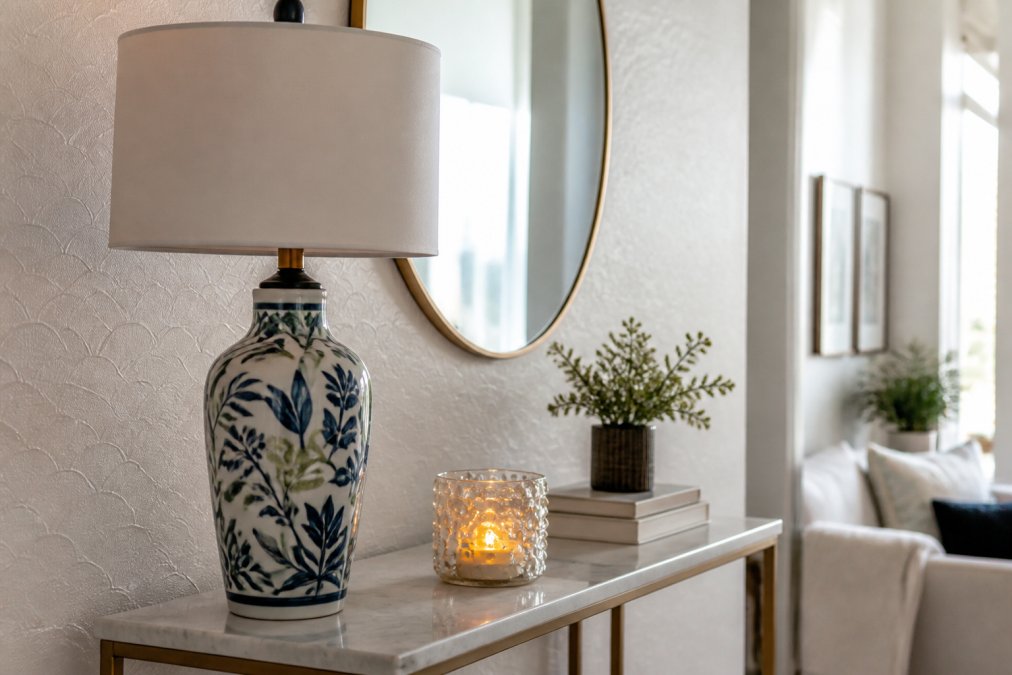
The biggest mistake renters make is treating their apartment as temporary. A common approach is to invest in one or two anchor pieces that carry real visual weight, then let everything else stay neutral and quiet. Mercury & Bloom's table lamp crafted from a hand-painted bottle at $90 is exactly that kind of anchor: sculptural, warm, and portable to your next address.
Curated shelves follow a simple rule: group in odd numbers, vary height, and leave negative space. A shelf styled edge to edge reads as clutter; one styled with breathing room reads as intentional. But the difference between a styled shelf and an elevated one comes down to a few mechanics most guides skip.
Work the vertical plane, not just the shelf. In a small room, the wall above a shelf is free real estate. Stack books horizontally to build a low riser, then lean a framed print or a small mirror against the back wall so it reflects light into the room. This is the same principle behind leaning art in rentals: it adds height without a single nail.
Build in threes, then break the pattern. A common pattern among stylists is to anchor each shelf with a stack of two or three books, add one tall object for vertical lift, and finish with one small handmade piece, like a beaded glass jar at $40. Then deliberately break the symmetry: shift the tall object off-center so the eye travels instead of stopping.

Match object scale to shelf depth. A deep shelf swallows small objects; a shallow shelf makes large ones look like they are falling off. As a rule of thumb, the tallest object on a shelf should be no more than about two-thirds the height of the space between shelves, and no object should overhang the front edge (bhg.com).
Try this sequence:
Renter note: if you cannot drill, use removable adhesive strips rated for the weight of your heaviest object, and keep the total load per shelf modest. A shelf that fails takes the styling with it.
Functional decor for tiny homes means every object earns its footprint by doing two jobs at once. A lidded jar stores small items and looks beautiful on a counter. A dispenser pours oil and doubles as a kitchen focal point. This is where form and daily use stop competing.
Mercury & Bloom's hand-painted olive oil dispenser at $65 is a working example: it lives on the counter, gets used every day, and still reads as artisanal rather than utilitarian.

The two-job test. Before buying any decor piece, ask what it does besides look good. If the answer is nothing, it has to be exceptional to justify the space. A piece that fails the test is not automatically out, a single sculptural object can be worth the footprint, but it should be the exception, not the rule.
Where multi-functional furniture fits. The same logic scales up. A storage ottoman holds blankets and serves as a seat. A console with drawers hides mail and anchors an entryway. A nesting side table pulls apart for guests and tucks away when they leave. The trade-off is real: multi-functional pieces are often heavier and less flexible than single-purpose ones, so buy them only where the function you are doubling is one you actually use daily.
Watch the weight and the walkway. In a compact room, a piece that is too heavy visually drags the space down, and a piece that is too deep blocks the path. Measure your walkway before you buy; most people find they need at least 30 inches of clear path to move comfortably.
A quick decision list:
Sustainable small space decor favors repurposed materials, natural fibers, and pieces made to last rather than trend. Repurposing keeps materials out of landfills and gives a room a story no mass-produced item can match. The EPA's guidance on reducing waste outlines how reuse sits above recycling in the waste hierarchy, which is exactly the logic behind buying repurposed decor.
Handcrafted pieces fit this model naturally. A jar made by an artisan, a lamp built from a repurposed bottle, a candle poured in small batches: these are objects with a longer intended life than a seasonal trend buy. When you shop, ask where a piece came from and who made it. Makers who can answer that question clearly are usually the ones building things to keep.
Elevated living in a compact room is less about square footage and more about how the space makes you feel. Research from the American Psychological Association on the home environment consistently links cluttered, visually noisy rooms to higher stress, while orderly, personalized spaces support a sense of calm and control. That emotional return is the real argument for decorating small spaces with intention.
Here is the part most guides miss: a small room amplifies whatever you put in it. One beautiful object reads as a focal point; five mediocre ones read as noise. This is why elevated decor in a compact home is an exercise in editing. You are not filling space. You are choosing what deserves to be seen.
Elevated home decor can look expensive on a modest budget when you spend on texture, scale, and light instead of quantity. A single well-chosen piece outperforms a shelf of cheap filler every time. The FTC's guidance on advertising claims is a useful reminder that "luxury" should describe real craftsmanship, not just a label, so buy from makers who can show their work.
| Strategy | Best For | Approximate Cost | Impact |
|---|---|---|---|
| Statement lighting | Renters, small corners | $65-$90 | High |
| Repurposed decor | Eco-conscious buyers | $40-$65 | Medium-High |
| Textural swaps | Any budget | Low | Medium |
| Layered lighting | Evening ambiance | Low-Medium | High |
The 3-5-7 rule is a styling guideline for arranging accessories in odd-numbered groups: three items of similar scale, five items mixing heights, or seven items with varied textures. In small rooms it prevents visual clutter by giving each surface a clear composition. Try it on a shelf or console: one tall piece, two medium pieces, and a few small accents. The odd count reads as intentional rather than scattered.
Focus on proportion, lighting, and a few handcrafted statement pieces instead of filling every surface. A single artisan lamp, like a hand-painted bottle lamp, can anchor a corner better than five mass-produced items. Layer ambient and task lighting, keep a neutral base palette, and add textural contrast through natural materials. Renters can achieve this with removable wallpaper, floor-to-ceiling curtains, and modular furniture that suits the room's scale.
In 2026, small-space decor leans toward sustainable, artisanal pieces and rental-friendly upgrades. Expect to see hand-painted ceramics, beaded glass jars, and repurposed glassware used as functional decor. Neutral color palettes with one bold focal point remain popular, as do modular designs that adapt as needs change. Shoppers are also prioritizing pieces that carry a story, favoring small-batch makers over mass-produced lookalikes.
Start by removing everything, then add back items in odd-numbered groupings with varied heights. Use the 70/30 rule: 70 percent of shelf space for display, 30 percent left open for breathing room. Mix books stacked horizontally with vertical accents, and lean one piece of art or a mirror against the back. Group by theme or color family, and swap seasonal items rather than adding more.
Decorating a small space well takes discipline, and it takes pieces worth keeping. Mercury & Bloom curates handcrafted home goods built for exactly that: a hand-painted bottle lamp, a beaded glass candle jar, a repurposed olive oil dispenser, each chosen for quality, beauty, and daily function. Browse the collection and add to cart to give your compact home the elevated finish it deserves.


