Your cart is empty
Tax included and shipping calculated at checkout

Drawer menu
Tax included and shipping calculated at checkout

Last Updated: September 15, 2026
A maker's material bill rarely matches what a shopper assumes it should be. When a customer wonders why handmade goods cost more, the answer usually starts at the workbench, not the checkout page. Handmade goods cost more because every input, from raw materials to time, is bought and paid for in small quantities rather than negotiated at industrial scale.
Raw materials are the first line item. Small-batch makers buy fabric by the yard, beads by the strand, and leather by the hide, often from specialty suppliers who charge retail or near-wholesale rates. A mass producer negotiating millions of units pays a fraction per piece (Plan your business). That gap alone can double or triple a maker's material cost before any labor is added.
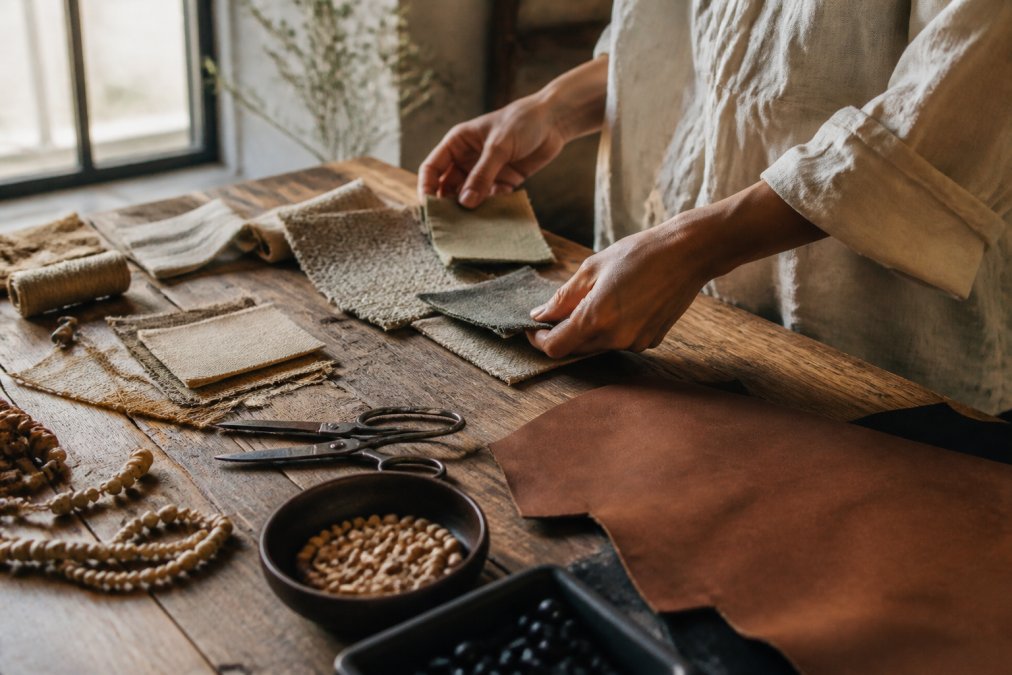
There's a second cost most buyers never see: waste. A handmade tote cut from a single length of velvet cotton leaves offcuts that can't always be reused. Precision cutting at scale minimizes that loss through nesting software and die presses. At a small bench, some waste is simply unavoidable.
Pricing handmade items correctly means accounting for three things: labor, overhead, and profit. Skip any one of them and the business runs on a hobby's economics, not a sustainable one.
A simple formula works for most small makers:
Price = (Materials + Labor + Overhead) × Markup
The markup covers profit and the cost of running a business. Many makers use a 2x to 3x multiplier on total cost, though the right number depends on your niche market and market positioning (score.org).
Start by deciding what your time is worth. A common approach is to set a target hourly rate, then use time-tracking to measure how long each piece actually takes, including prototyping, setup, and finishing. Most makers underestimate production time by a wide margin because they forget the invisible steps: sourcing, packing, photography, and customer messages.
If a beaded glass jar takes two hours of focused work and your rate is $25 per hour, that's $50 in labor before materials. A piece that sells for $40 cannot survive that math, which is why honest time-tracking reshapes product lines fast.

Overhead is everything that keeps the lights on: rent or a dedicated workspace, electricity, equipment depreciation, software, packaging, and payment processing fees. These operational expenses exist whether you sell one piece or fifty.
The practical fix is to calculate a per-unit overhead rate. Add up monthly overhead, divide by the average number of units you produce, and add that figure to each item's cost. A maker producing 100 units a month with $600 in overhead carries $6 of overhead per piece, and that number belongs in the price, not in the maker's pocket (Plan your business).
| Cost Component | What It Includes | How to Calculate |
|---|---|---|
| Raw materials | Fabric, beads, leather, hardware | Track per finished piece |
| Labor | Production, finishing, packing | Hourly rate × production time |
| Overhead | Utilities, tools, workspace, fees | Monthly total ÷ units produced |
| Profit markup | Reinvestment and income | 2x-3x multiplier on total cost |
Handmade versus mass produced quality diverges most sharply at the point of inspection. A mass-produced item is built to a tolerance that keeps a production line moving; a handmade item is built to a standard the maker sets and checks by hand.
That difference shows up in the details. Hand-finished edges, matched patterns, and individually set beads require attention to detail that automated lines don't prioritize. Quality control at scale means sampling a batch; quality control at a bench means inspecting every piece.
Small-batch production lets a maker adjust in real time. If a dye lot runs warm or a clasp feels flimsy, the maker catches it before fifty units ship. That responsiveness is a genuine advantage, and it's also where the "scale trap" hides.
The scale trap is the assumption that growing means producing more of the same thing faster. In practice, scaling a handmade business often means either hiring and training (which dilutes the maker's hand) or investing in equipment that changes the product's character. Economies of scale exist, but they come at the cost of the very craftsmanship that justifies the price. Makers who chase volume without that trade-off in mind often end up competing with mass-produced goods on mass-produced terms, and losing.
The benefits of buying handmade products extend well past the object itself. Buyers get a piece made in limited quantities, often with customization options a factory can't offer, and they support skilled labor directly rather than a supply chain of intermediaries.
There's also the matter of uniqueness. A bespoke or small-batch item carries a design that isn't replicated thousands of times, which matters to shoppers building a personal aesthetic rather than following a trend. Sustainability often factors in too: shorter supply chains, repurposed materials, and ethical production practices are common in artisan work, though buyers should verify claims rather than assume them.
At Mercury & Bloom, that curation is the point. The collection spans handcrafted pieces like the Handmade Beaded Glass Jars/Candles, made by skilled artisans, and the Quilted Velvet Tiger Tote Bag, a reversible, eco-friendly carry made in limited runs. Each piece is selected for quality, beauty, and function rather than volume.

Perceived value and actual cost rarely align, and consumer psychology explains why. Shoppers anchor to the prices they see most often, which are mass-produced prices. Against that anchor, a handmade piece looks expensive even when its price barely covers materials and labor.
The anchoring effect is compounded by invisibility. A buyer sees the finished object, not the two hours of production time, the rejected prototypes, or the maker's rent. When the work behind a piece is hidden, the price feels arbitrary.
Every shopper walks in with three reference prices, and a handmade price only feels fair when it beats at least one of them:
A common pattern is a three-tier structure:
| Tier | Role | Typical Position |
|---|---|---|
| Entry | Lowers the barrier, introduces the craft | Small, simple, lower material cost |
| Core | The piece you actually want to sell | Mid-price, best margin, signature design |
| Signature | Anchors the top and makes Core look reasonable | Complex, limited, highest labor hours |
A common formula is (materials + labor + overhead) x 2. Labor should be based on a fair hourly rate, not a guess. Track production time for each item. For example, if a tote bag takes 3 hours at $25/hour plus $15 in materials, your base cost is $90. Doubling that covers overhead and profit. Many makers undercharge by forgetting overhead.
Unlike mass-produced goods, handmade items cannot spread labor across thousands of units. A single artisan might spend hours on one piece, from cutting and stitching to quality control. That time is the core cost. When you buy a handmade tote bag or beaded jar, you are paying for skilled hands, not machine speed. This is why handmade goods cost more.
Handmade products often offer better quality control, unique designs, and ethical production. You support real craftspeople, reduce mass-produced waste, and get items with attention to detail. For example, a handpainted olive oil dispenser from Mercury & Bloom is a one-of-a-kind piece, not a factory copy. These benefits justify the higher price for many buyers.
Not always, but handmade often wins on precision and customization. A skilled artisan can spot flaws that a production line misses. However, some factory items use advanced technology for consistency. The key difference is that handmade quality reflects the maker's care, while mass-produced quality reflects the machine's settings. For unique, durable pieces, handmade offers a distinct aesthetic and attention to detail.
The challenge for any handmade business is holding a price that covers materials, skilled labor, and overhead without apologizing for it. Mercury & Bloom builds its collection around exactly that principle, curating handcrafted pieces with high standards for quality, beauty, and functionality, from beaded glass jars to reversible quilted totes. If you want accessories and home goods made with intention rather than volume, explore the Mercury & Bloom collection and add to cart with confidence.


