• Posted on

How to Spot Authentic Artisan Work: 7 Signs to Check

How to Spot Authentic Artisan Work: 7 Signs to Check

Table of Contents

Last Updated: September 28, 2026

What Separates Artisan-Made from Mass-Produced

Spotting authentic artisan work starts with one truth: a machine can copy a shape, but not the decisions a person makes along the way. Authentic artisan work is any object made by a skilled maker who controls the tools, materials, and finishing by hand, in small batches, rather than on an assembly line.

The Human Hand in the Manufacturing Process

Every handmade object passes through human hands at each stage: the maker picks the material, shapes it, and decides when it's finished. Mass-produced goods flip that order, a machine stamps out thousands of identical units, and a worker only feeds it, so the maker's judgment disappears. You can often feel this: run your fingers along an edge, and a handmade piece usually has a soft, slightly uneven finish where a person sanded it, while a factory edge feels razor-uniform, sometimes sharp. That variation isn't a flaw.

How to Identify Mass-Produced vs Handmade in 60 Seconds

You can usually tell mass-produced from handmade in under a minute by checking four things: the base, the seams, the weight, and the story.

  1. Flip it over. Look for a maker's mark, a signature, or a date.
  2. Check the seams. Hand-sewn or hand-joined lines wobble slightly. Machine lines are perfect.
  3. Weigh it in your hand. Handmade goods often feel denser or slightly uneven.
  4. Read the tag. A vague "designed in" label with no maker named is a warning sign.
Pro Tip Ask the seller one question: "Who made this, and where?" A real maker or curator can answer in seconds. A reseller of mass-produced goods usually can't.

Physical Markers of Authentic Artisan Work

The fastest proof of authentic artisan work lives on the object itself. Look for tool marks, texture, and hand-finished edges before trusting any label. Hand-shaped wood, clay, or glass rarely feels perfectly smooth, you'll find faint plane marks, brush lines, or the swirl of a polishing cloth. A hand-finished edge catches light unevenly, while a machine-cut edge is dead straight.
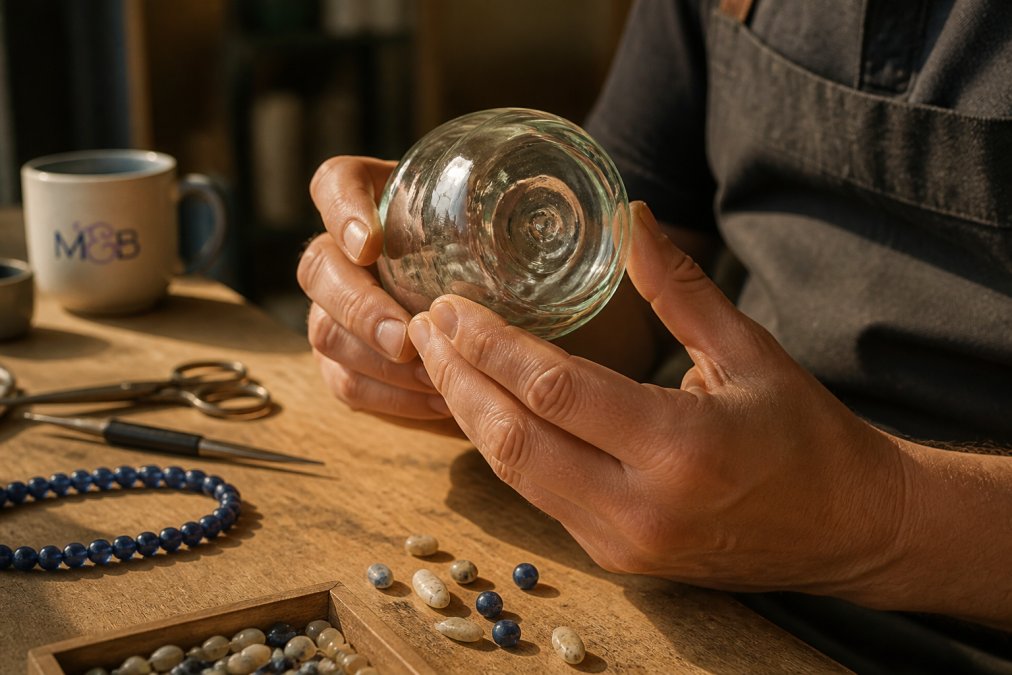
Diagram detailing physical markers of authentic artisan work in hand-blown glass

Tool Marks, Texture, and Hand-Finished Edges

Tool marks are the fingerprints of a maker: a potter leaves ridges, a glassblower a faint swirl, a woodworker plane tracks.

Maker Marks, Signatures, and Pontil Marks

A maker mark is a stamp, signature, or symbol a craftsperson puts on their work to claim it as their own. It's one of the strongest signs of authenticity you can find.

Signs of High-Quality Craftsmanship in Any Material

High-quality craftsmanship shows up the same way across wood, glass, clay, and cloth. The material changes. The standards don't.

Here's what to check on any piece:

  • Weight and balance. A well-made object feels solid and sits level.
  • Clean joins. Seams line up, hinges sit flush, and nothing rattles.
  • Even finish. No drips, bubbles, or skipped spots in the coating.
  • Thoughtful details. A lined interior, a reinforced strap, a smooth closure.
  • Consistent style. The design choices match across the whole piece.

Why Handmade Goods Cost More (and When That Price Is Justified)

Handmade goods cost more because a person, not a machine, does the work. One maker might finish a handful of pieces in a day. A factory line can finish thousands.

When is the higher price fair? Ask three questions:

  • Does the maker's time show in the details?
  • Is the material clearly better than a cheap alternative?
  • Will the piece last longer or mean more to you?
Watch Out A high price is not proof of handmade quality. Some sellers charge artisan prices for factory goods. Always check the physical markers before you let price convince you.

Provenance, Traceability, and Digital Verification Tools

Provenance is the documented history of an object: who made it, where, and how it reached you. Traceability is your ability to follow that chain from maker to buyer. Together they're your best defense against fakes, but only if you know what each verification tool can and cannot prove.

What Provenance Actually Looks Like

Real provenance is specific: a seller with genuine provenance can name the studio, the region, and often the individual maker, show photos of the work in progress, and explain what materials were used and why.

Digital Verification Tools: What Each One Proves

Digital tools have made provenance easier to verify, but they are not equally strong. Here's how the main options compare:

  • QR codes. A QR code on a tag or certificate links to a page with the piece's details. Strength: easy to use. Limitation: it only proves someone created a page, not that the object in your hand is the object described, unless the code is physically tied to the piece in a way that can't be copied.
  • Serial numbers. A unique number stamped, engraved, or written on the piece, matched to a record held by the maker or studio. Strength: hard to duplicate at scale. Limitation: only useful if the maker maintains a registry you can query.
  • Certificates of authenticity (COA). A physical or digital document naming the maker, date, materials, and sometimes the edition. Strength: standard in art, jewelry, and collectibles. Limitation: a COA is only as trustworthy as its issuer, one printed by the seller proves nothing on its own.
  • Blockchain records. A tamper-resistant ledger entry tying a piece to a maker and a timestamp. Strength: once written, the record cannot be quietly altered. Limitation: blockchain proves the record exists and hasn't changed, not that the physical object in your hand is the one described. The link between record and piece still depends on a trusted handoff.

A Practical Verification Sequence

Use this order next time you buy a piece marketed as artisan-made:

  1. Ask for the maker's name and location before buying. If the seller can't answer, stop.
  2. Request a photo of the actual item, not a stock image. A real maker can produce one in minutes.
  3. Look for a certificate, tag, or card naming the studio. Then check whether the studio exists outside the seller's site.
  4. Search the maker's name. Confirm they sell elsewhere, have a portfolio, or have been written about.
  5. If a QR code, serial number, or COA is offered, use it, then verify the underlying claim. Scan the code, look up the serial, and check whether the studio named on the certificate made the piece.
  6. Cross-check the physical markers. A pontil mark on "hand-blown" glass, tool marks on wood, slight variation in hand-dyed color. Digital records and physical evidence should agree.

Why Curation Shortens the Chain

Tracing every piece yourself is time-consuming, and most shoppers won't do it. That's where curation earns its place: when a shop vets its makers and can name them, you don't have to trace every piece from scratch. That's how we run our collection at Mercury & Bloom, each piece is selected with intention.

Shop Now →

If a seller offers a certificate of authenticity but cannot name the maker, the certificate is decoration. Provenance starts with a person, not a document.

The 'Fake Artisan' Market: Red Flags and How to Verify Before You Buy

The "fake artisan" market is the fastest-growing problem in online shopping, and it runs on a specific playbook: rustic photos, handmade-sounding language, and high prices to move factory goods. Understanding how it works is the fastest way to defeat it.

How the Fake-Artisan Playbook Actually Works

Most fake-artisan listings follow the same four-step pipeline:

  1. Source from a mass-manufacturer. A factory produces the item in bulk, often in the same facility that supplies big-box retailers, at a fraction of the retail price.
  2. Scrape or stage the photos. Sellers pull images from real artisans' portfolios, or stage a single "workshop" photo, hands, a wood table, some tools, reused across dozens of listings. Reverse-image search often reveals the same photo on multiple storefronts.
  3. Write the story. The listing gets a vague origin ("handcrafted by skilled artisans"), a feel-good mission statement, and a price that signals quality without triggering suspicion.
  4. Farm the reviews. Early reviews are bought, incentivized, or generated, so by the time real buyers post, a wall of five-star ratings buries the complaints.

This is why the fake-artisan problem is hard to spot with a quick glance: every individual signal, the photo, the story, the reviews, looks fine on its own. The fraud lives in the pattern.

Red Flags That Survive a Closer Look

Watch for these, especially in combination:

  • Vague maker info. "Designed in" with no maker named, or a studio name that returns no results outside the seller's own site.
  • Perfect consistency. Every unit looks identical, even in "limited" runs. Real handwork varies.
  • Stock photos only. No real photos of the actual item, or the same photo on multiple unrelated storefronts.
  • Too-good pricing. Real handwork costs real time. A "hand-carved" piece priced below the cost of the raw material is a math problem, not a bargain.
  • No return policy, or a return address that doesn't match the story. Honest sellers stand behind their goods.
  • A story that changes. Ask the same question twice and the answer shifts. Real makers are consistent because they're describing something that actually happened.
  • Reviews that cluster. A burst of five-star reviews in one week, followed by a trickle of one-star complaints about quality or shipping, is a classic pattern.

How to Verify Before You Buy

Verification is a short sequence, not a single check:

  1. Reverse-image search the product photo. If it appears on other storefronts under different brand names, walk away.
  2. Search the maker's name outside the seller's site. A real artisan usually has a portfolio, social presence, or press coverage predating the listing.
  3. Ask for a real photo or short video of the actual item. A maker can produce one in minutes. A dropshipper cannot.
  4. Ask one specific question about the process. "What clay body did you use?" or "How long does one of these take to bead?" Real makers answer in specifics. Resellers pivot to policy.
  5. Check the return policy and business address. A mismatch between the "handmade in" story and the return address is a strong tell.
  6. Read the one- and two-star reviews first. They describe the item that actually arrived, not the item in the marketing photos.

A high price is not proof of handmade quality, and a low price is not proof of a scam. Price is a signal, not a verdict. The verdict comes from the maker's name, the origin story, and the physical evidence in the piece itself.

The single best test of authenticity is a named maker plus a clear origin story plus physical proof in the details. If a seller can't give you all three, treat the "handmade" label as marketing until proven otherwise.

A Quick Reference: Red Flags and What to Do

Use this table the next time you shop, whether online or in person.

Red Flag What It Usually Means What to Do
No maker named Reseller or factory goods Ask who made it
Perfect uniformity Machine production Check for tool marks
Stock photos only Item may not exist as shown Request real photos
No pontil mark on "hand-blown" glass Molded, not blown Inspect the base
Vague "artisan" claims Marketing language Ask for provenance
No returns accepted Seller avoids accountability Buy elsewhere

Where to Find Pieces You Can Trust

The easiest way to avoid fakes is to buy from a curator who does the checking for you. That's our role at Mercury & Bloom. We stock handcrafted goods with clear origins, like our It Is What It Is Beaded Coin Purse, handcrafted in India from 100% premium cotton with a hand-beaded design, and our Handpainted Clase Azul Olive Oil Dispenser, each one hand-painted in Mexico so no two are exactly alike.

Handpainted Class Azul 750ml Olive Oil Dispenser Handpanted Clase Azul Olive Oil Dispenser
It Is What It Is Beaded Coin Purse

Frequently Asked Questions

What are the key indicators of handmade artisan work?

Look for intentional variation between identical pieces, visible tool marks, and a maker mark or signature. On glassware, a pontil mark on the base is a strong signal of hand-blown production. On textiles and beadwork, slight differences in stitch tension or bead placement show a person worked the piece by hand rather than a machine stamping out identical units. Provenance details, such as the artisan studio's name and location, add further confirmation.

Are there specific imperfections that prove an item is handmade?

Not every imperfection proves handmade origin, but certain types do. Slight asymmetry in a ceramic rim, uneven glaze pooling, or beadwork where one row sits a millimeter off are consistent with hand-crafted production. Machine-made items tend to have uniform flaws from mold wear, not organic variation. The key distinction is whether the variation looks like a human decision or a manufacturing defect. Intentional variation is a feature; a cracked seam is not.

How do you verify the authenticity of artisan-made accessories online?

Start with the product listing. A genuine artisan brand names the maker, the studio location, and the materials used. Look for photos showing the item from multiple angles, including the base or underside where maker marks appear. Some sellers now offer digital verification through QR codes or certificates of authenticity. If a listing has only stock-style photos and no maker information, ask the seller directly before buying. A legitimate artisan studio will answer provenance questions without hesitation.

Why do handmade goods cost more than mass-produced alternatives?

The price gap comes down to time, skill, and scale. A single artisan might spend four to eight hours on one beaded glass jar, while a factory produces thousands per day with automated equipment. Small-batch production also means higher material costs per unit because studios buy in smaller quantities. Ethical sourcing, fair wages, and quality control done by hand all add to the final price. When you pay more for artisan work, you are funding the maker's time and expertise, not a middleman's markup.

Read Also

See all News
Best Sustainable Home Decor Brands 2026
  • Posted on
Best Sustainable Home Decor Brands 2026
Discover the best sustainable home decor brands for 2026. Shop handmade, eco-friendly pieces with ethical sourcing and natural materials.
7 Creative Mahjong Party Favors for Guests
  • Posted on
7 Creative Mahjong Party Favors for Guests
Seven creative mahjong party favors for guests, from beaded pouches to custom card sleeves, with prices and packaging tips for your next game night.
Best Functional Pouches for Parenting Needs
  • Posted on
Best Functional Pouches for Parenting Needs
Find the best functional pouches for parenting. Compare stylish, durable options designed for daily essentials, organization, and on-the-go convenience.
What Makes Handcrafted Goods Worth It
  • Posted on
What Makes Handcrafted Goods Worth It
Handcrafted goods worth: Discover why handcrafted goods cost more and deliver real value. Learn quality markers, sustainability impact, and cost-per-use.