Your cart is empty
Tax included and shipping calculated at checkout

Drawer menu
Tax included and shipping calculated at checkout

Last Updated: September 21, 2026
Custom sneakers sizing starts with one reliable number: your heel-to-toe length in centimeters. This guide walks through the full fit process, from measuring at home to troubleshooting a pair that arrives slightly off. Get this first step right and width, volume, and break-in become far easier to manage.
Here is the sequence that works:
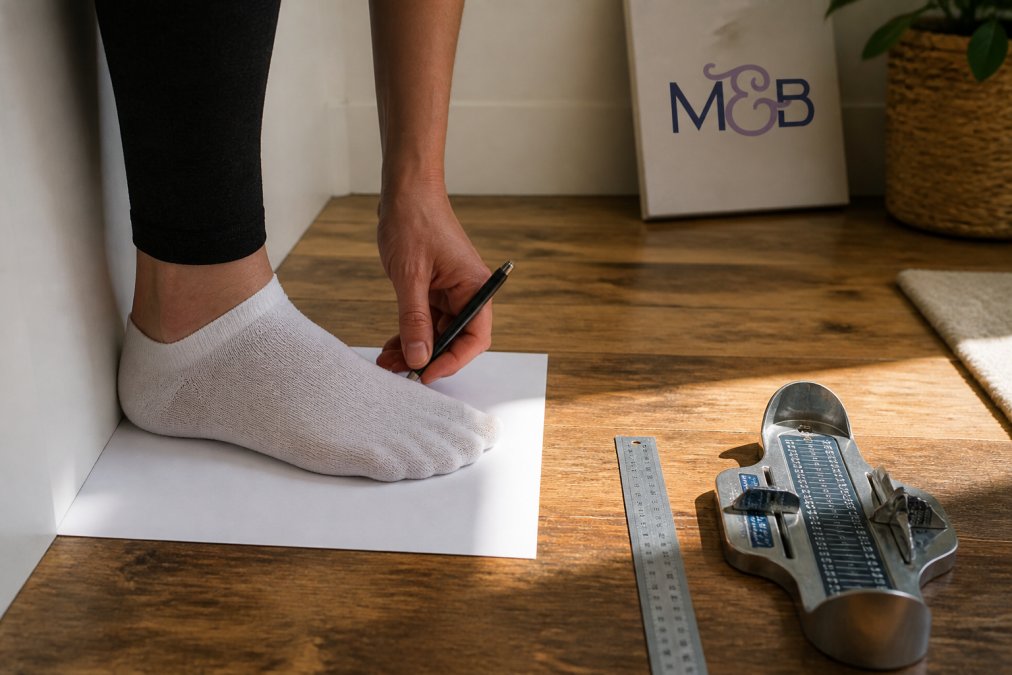
A Brannock device gives you length and width in one sitting, but paper and a ruler get you close if you are careful. According to guidance from the American Podiatric Medical Association on proper foot measurement, measuring both feet matters because most people have one foot slightly longer than the other.
Two feet can share the same length and still fit differently. Width and volume are separate measurements, and custom sneakers sizing has to account for both.
Foot width is the distance across your forefoot at its widest point. Foot volume is how much space your foot takes up inside the shoe, top to bottom. A high instep or thick midfoot can make a shoe feel tight even when length is perfect.
The practical test: if a shoe pinches across the ball of your foot, that is width. If it presses down on the top of your foot or the laces gap, that is volume. Treating these as the same problem is the most common mistake in the fit process.
For custom sneakers, both matter more than in mass-market shoes. A standardized last is built around an average foot that may not resemble yours. When you order made-to-order footwear, that single adjustment can solve fit issues no amount of breaking in will fix.
The right width lets your forefoot spread naturally without sliding. Use this guide to translate your measurement into a decision.
| Your Situation | Width Signal | What to Request |
|---|---|---|
| Ball of foot pinches, toes feel crowded | Too narrow | Size up in width, keep length |
| Foot slides side to side when walking | Too wide | Narrow the width or add an insole |
| Heel slips but forefoot fits | Length or heel shape issue | Check heel-to-toe length again |
| Top of foot feels pressure | High volume | Request more instep room |
| Laces gap when tied | High instep | Adjust last shape or lacing |
Split sizing exists for a reason: asymmetrical feet are the norm. If your feet differ by half a size or more, ordering each shoe to its own measurement can be beneficial rather than compromising on both.
Mercury & Bloom's Spirit Shoes - Custom Converse Shoes are made to order in any size, so you can specify the fit you need rather than squeezing into a stock range, the difference between a shoe you wear once and one you wear weekly.

Length and width get all the attention, but the fit problems that send custom sneakers back for a remake usually come from volume, the three-dimensional space inside the shoe. Three things change it after you measure: socks, insoles, and the shape of your arch and instep.
Socks change your effective size. A thin dress liner adds roughly 1-2 mm; a cushioned athletic sock can add 4-6 mm.
When you order custom, telling the maker three things beyond length, your sock weight, whether you wear an orthotic, and whether you have a high or flat arch, can help them adjust the last shape and internal volume before the shoe is built.
Custom sneakers still need a gradual introduction. The goal is to let the material mold to your foot without creating lingering pressure points.
Step 3: Match the symptom to the cause.
| Symptom | Most likely cause | Fix before requesting a remake |
|---|---|---|
| Heel slips up and down | Length too long, or heel cup too wide | Heel grip, thicker sock, runner's loop lacing |
| Toe presses the front | Length too short, or thick insole added | Remove added insole, switch to thinner sock |
| Ball of foot pinches | Width too narrow | Nothing fixes this, width change needed |
| Top of foot presses down | Instep volume too shallow | Relace, remove insole, thinner sock |
| Foot slides side to side | Width too wide | Add a thin insole or tongue pad |
| One shoe fits, one does not | Asymmetrical feet | Split sizing, order each shoe to its own measurement |
The fit process ends when the shoe fits, and the more precisely you describe what is wrong, the faster that happens.
Getting custom sneakers sizing right comes down to measuring both feet in centimeters, accounting for width and volume separately, and choosing your socks before you measure. Do that up front and the break-in period becomes a formality rather than a gamble.
Sizing up can be recommended if you are between sizes, especially for closed-toe styles, as a slightly larger fit allows room for toe box clearance and accommodates thicker socks or custom orthotics. However, sizing down can work for open styles or if the maker confirms the last runs wide. Always check the maker's specific size chart and fit recommendation before ordering.
Stand on a piece of paper with your heel against a wall. Mark the tip of your longest toe and measure from the wall to that mark in centimeters. Repeat for both feet, as asymmetrical feet are common. Measure width at the widest part of your forefoot. Use these numbers with the maker's size chart, and add 0.5 cm for toe room if you plan to wear thick socks.
Yes, custom sneakers can fit differently. Handcrafted pairs can have a break-in period, while mass-produced shoes follow standardized sizing. Always request the maker's specific measurements and ask about the last shape. If you wear custom orthotics, share those dimensions with the maker for a better fit.
Foot width is just as important as length. A shoe that is long enough but too narrow causes forefoot pinching and heel slippage. Measure your forefoot width in centimeters and compare it to the maker's width options. If your width falls between sizes, choosing the wider option and adjusting with laces or insoles can be helpful.
Order for your larger foot and use an insole or heel grip in the smaller shoe. Measure both feet separately and provide both measurements when ordering. This prevents the common mistake of fitting only the smaller foot and ending up with a tight shoe on the larger one.
Start by measuring your feet in the afternoon when they are slightly swollen. Choose breathable materials and consider the thickness of socks you will wear most. During the break-in period, wear them for short sessions. If discomfort persists, contact the maker about adjustments or returns.


