Your cart is empty
Tax included and shipping calculated at checkout

Drawer menu
Tax included and shipping calculated at checkout

Last Updated: October 25, 2026
Quick Summary
Mahjong is the best social game for adults because the in-person mahjong social game is a structured excuse to sit across from each other for two hours without a screen, giving conversation a natural shape. You can learn the basic rules in one sitting and play a full hand within an hour.
Mahjong is a tile-based game for four players in which skill, strategy, and constant table talk matter as much as the tiles themselves. It has become the social game of the moment: according to Eventbrite data reported by The Wall Street Journal, mahjong event listings rose nearly 200% from 2023 to 2024, while Yelp searches for mahjong clubs climbed 4,467%. At Mercury & Bloom, we have watched this quiet revival turn into a full-blown ritual of weekly tables, themed accessories, and grown-up game nights.
The appeal is simple. Adults want a reason to sit across from each other for two hours without a screen in the middle.
Below: the real benefits, the shorter-than-you-think learning curve, how to host a night people ask to repeat, and the gear that makes a table feel intentional.
The benefits of playing mahjong stretch well past the scorecard. A 2024 scoping review indexed in PubMed Central found that studies of players aged 60 and older reported stable or improved cognitive function and better eye-hand coordination than non-players. The same review linked the game to social and emotional support.
Mahjong demands memory, focus, and strategic thinking at the same time. You track discards, read the table, and revise your hand as tiles change. Researchers publishing in Frontiers in Public Health in 2025 found that mahjong and bridge participation was positively associated with subjective well-being, and the association held across multiple regression tests.
For adults juggling work and family, a game night that also trains decision-making beats another scroll session.
Loneliness is the quiet problem behind a lot of adult social life. The University of Georgia College of Public Health reports that regularly playing mahjong was among several forms of social participation linked to reduced rates of depression among older adults.
In practice: four people, one table, and two hours of conversation broken up by the clatter of tiles. NPR reported in January 2026 that more people are picking up the game and finding community through it.
Mahjong for beginners is easier than the tile wall suggests: you can learn the basic rules in one sitting and play a full hand within an hour.
Here is what actually takes time:
A common mistake is trying to learn every regional rule at once. Pick one style, play five hands, and let the rest settle in. Most new players are functional by the second meetup.
Hosting a mahjong night comes down to four things: a table, a set, a snack plan, and a group of four. Set a start time, keep the guest list to four, and print a one-page rules sheet for anyone new. The difference between a one-off night and a standing ritual is the right four people, one clear format, and a first-timer who feels at home by the second hand.
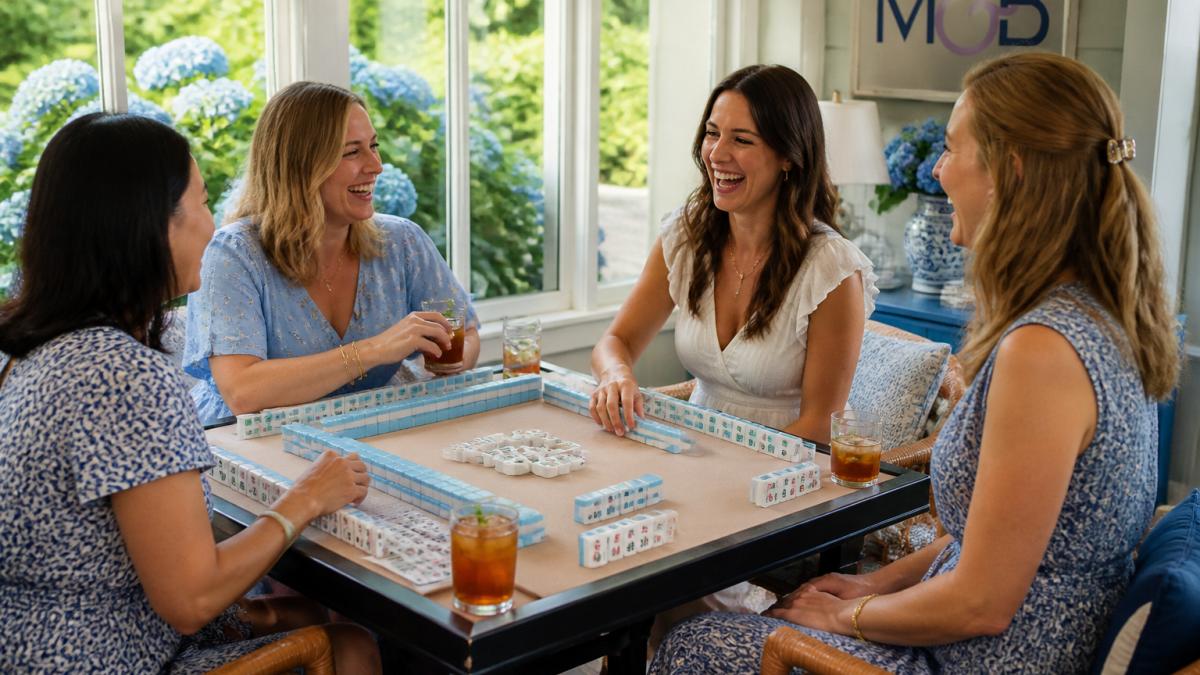
The most common failure mode is a beautiful table for three. Adults are busy, and a four-person game has no slack for a late cancellation. Build a roster of six to eight and rotate four per session so one conflict does not cancel the night. Where to look:
Regional rule sets differ enough that four people who each learned a different version will spend the night negotiating instead of playing. Pick one beginner-friendly style, name it in the invitation, and stick with it for the first several sessions with a printed reference card at each seat.
A few format decisions worth making before the first night:
Recurring plans turn a game into a friendship. Pick a fixed night, the second Tuesday, for example, and keep it even when one person cannot make it. A predictable schedule kills the "are we still on?" text thread; confirm the foursome two days ahead with a repeating calendar invite.
The first ten minutes decide whether a beginner comes back. A few low-effort moves do most of the work:
The stress usually comes from logistics, not the game:
Our Mahjong Tile Bag keeps the set together and travels easily.
Mahjong game night ideas work best when they repeat a format people already like. Rotate hosts, keep the same start time, and add one small ritual each week: a themed drink, a favor at each seat, or a running scorecard.
A few that land well:
If you want ready-made favor ideas, our guide to creative mahjong party favors has options that suit a casual table or a dressed-up one.
The table sets the tone before anyone draws a tile. Our Hydrangea Blue Mahjong Table is a 42-inch square with an extra-wide playing surface, room for a mat, card, and drink, in a color that works in a sunroom or game room.

Best for: hosts who want a permanent game surface that doubles as decor. Skip if: you play at a different house every week and need something portable.
Online mahjong is convenient and teaches the rules quickly. In-person play delivers what most adults are missing: face-to-face interaction, shared experience, and the low-grade social pressure that keeps a group showing up. The honest comparison is what each is good at, and how to use both without letting the screen replace the table.
Digital mahjong earns its place as a training tool: available at any hour, it enforces the rules automatically and lets a beginner play dozens of hands without inconveniencing three other people. Pattern recognition comes from volume, and a phone or browser game provides volume on demand. It is also a reasonable fallback when the table cannot meet, a snowstorm, a travel week, a new baby.
What online play cannot do is replicate the table. The tactile part of the game, the shuffle, the click of tiles, the physical act of drawing and discarding, is not decoration. It is the shared rhythm that gives the group something to talk around.
The in-person mahjong social game is a structured excuse for adults to sit across from each other for two hours. It gives a group a reason to meet that is not work and not family, and gives conversation a natural shape: talk during the shuffle, focus during the hand, talk again after the score. Adults who struggle to schedule a plain dinner often say yes to a game night because the activity carries the social load.
The table also adds the parts of friendship that screens flatten:
| Factor | Online Play | In-Person Play |
|---|---|---|
| Convenience | High, play any time, alone or remote | Lower, requires four people in one place |
| Cost | Low to free for many apps | Set, table, snacks, and hosting effort |
| Learning speed | Fast for rules and pattern recognition | Slower, but coached by real players |
| Social value | Low, mostly solo practice | High, conversation, ritual, friendship |
| Best use | Drilling rules between meetups | The standing adult game night |
A workable pattern for most adult groups is to treat online play as homework and the table as the main event. Use a digital game to learn the tiles and basic hand shapes during the week, then bring the group back to a real table where the social value lives. If a regular player moves away, a periodic online session can keep them in the group between in-person nights.
Building your mahjong table before the first meetup is the difference between a nice idea and a standing date. Start with the essentials, then add personality once the group forms. Our mahjong accessories checklist covers the gear a social table needs.
The pieces we would start with:
Our Mahjong Cheers Charms at $24.50 for a set of six make an easy finishing touch, and the Table Talk Acrylic Coaster Set at $40.00 keeps the table looking intentional. For the full look, the Mahjong Social Mock Neck Sweatshirt at $62.00 is built for exactly this kind of night.


| Setup Step | What You Need | Why It Matters |
|---|---|---|
| Choose the surface | 42-inch square table | Room for four hands, a card, and drinks |
| Prep each seat | Racks and a tile line | Faster setup, fewer disputes |
| Protect the table | Coasters and a mat | Keeps surfaces clean and drinks stable |
| Add the ritual | Charms or favors | Gives the group a reason to return |
| Store and travel | Bag with wrist strap | Keeps the set together between weeks |
Yes, and the research is more specific than most people expect. A 2024 scoping review in PubMed Central found that studies of players aged 60 and older reported stable or improved cognitive function and better eye-hand coordination than non-players. Researchers publishing in Frontiers in Public Health in 2025 found that mahjong and bridge participation was positively associated with subjective well-being across multiple regression tests. The University of Georgia College of Public Health also reports that regular mahjong play was among the social activities linked to lower depression rates in older adults.
Four players make a standard game, which is one reason mahjong works so well for a recurring social game night: you only need to fill a table, not a room. Three players can run a modified game, and many beginners start with two people simply sorting tiles and practicing hands. If you are building a group, invite five or six so a single absence does not cancel the night. That small headcount is also why mahjong for beginners is easier to organize than a team sport or a large dinner party.
No. The recent growth is broad. Eventbrite-reported mahjong events increased nearly 200% from 2023 to 2024, according to The Wall Street Journal, and NPR reported in January 2026 that more people are picking up the game and finding community connections. Interest spans college students, sorority members, working mothers, and retirees, which makes mahjong an unusually age-inclusive social game. The rules stay the same whether you are 22 or 72, so mixed-age tables work naturally.
At minimum: a mahjong set, a table large enough for four racks, and a printed playing card so new players can follow along. A 42-inch square table gives each player room for a rack, a drink, and their tiles without crowding the mat. Add coasters to protect the surface, a small snack spread, and a cheat sheet of hand patterns. Keep the first night to two or three rounds so nobody feels trapped at the table, and send everyone home with a hand reference for next time.
The hardest part of a mahjong habit is not the rules. It is getting four adults in the same room on a regular basis. Mercury & Bloom makes that easier with handcrafted pieces designed for the table: an extra-wide mahjong table that anchors the room, beaded and embroidered accessories that turn game night into an occasion, and small charms that make every seat feel considered. Get started with Mercury & Bloom and build a table your group will want to come back to.


