Your cart is empty
Tax included and shipping calculated at checkout

Drawer menu
Tax included and shipping calculated at checkout

Last Updated: September 18, 2026
A hand-thrown ceramic mug takes an artisan roughly 45 minutes to shape, glaze, and fire. A factory can press out thousands in the same window. That gap is the whole story behind why handmade goods cost more, and it's the first clue when you're learning how to spot authentic handmade goods.
Handmade goods are objects made by a person using their hands and tools, not assembled on an automated production line.
The price reflects time, skill, and materials that a machine-driven process can't copy. At Mercury & Bloom, we built our whole collection around that idea. Every piece is chosen because a real maker shaped it.
So why does it matter to you?
That's the throughline for everything below. Once you understand the cost, the tells become obvious.
You can identify artisan craftsmanship by looking for the small marks machines can't make: uneven edges, visible tool work, and materials with natural grain. Below, we'll show you exactly how to run seven quick checks before you buy.
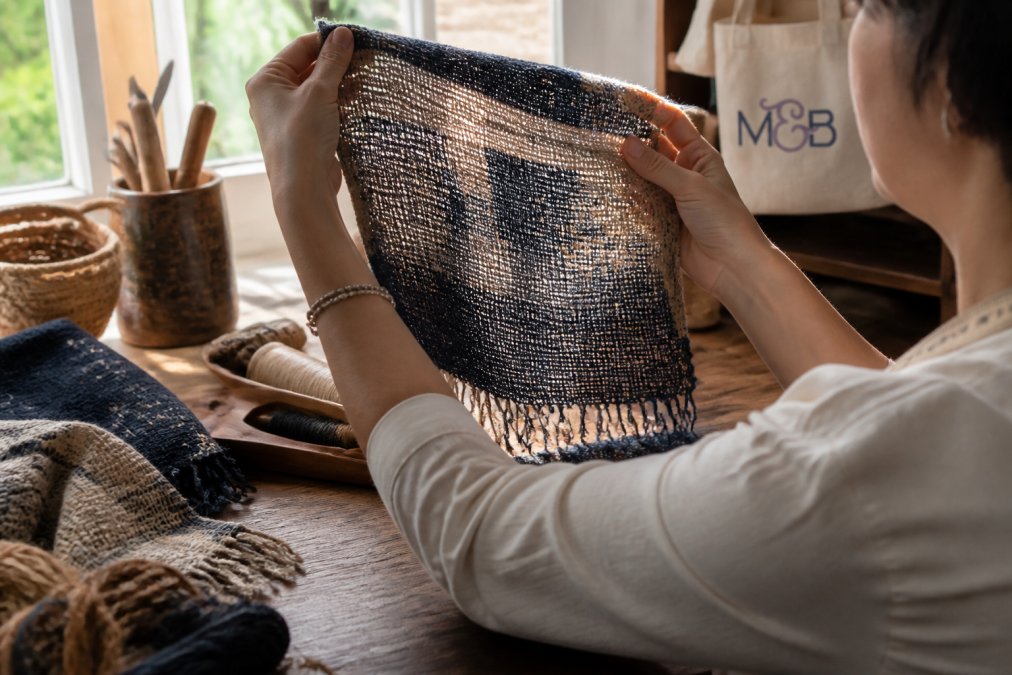
Tool marks are the fastest giveaway. A hand-carved wooden bowl shows faint chisel lines. A hand-painted piece shows brush strokes that vary in thickness. Machine work is eerily uniform.
Flip the item over. Look at the stitching on a leather bag or a textile edge. Hand stitching is slightly uneven and often denser at stress points. Factory stitching runs in a perfect, identical line.
Run your fingers across the surface. Natural materials like leather, wood, and wool feel warm and change slightly with handling. Synthetic copies feel slick and cold.
A common mistake is judging by look alone. Photos hide a lot. In practice, touch tells you more in five seconds than a screen ever will.
Mass-produced items are identical to each other. Handmade items are unique, even within the same batch.
Ask yourself: does this piece look exactly like the last one I saw? If yes, it's likely factory-made. Small irregularities are a feature, not a defect.
Buying handcrafted products gives you durability, individuality, and a direct line to the person who made your item. Many buyers find these pieces last longer because makers use better materials and slower methods.
The benefits stack up beyond the object itself:
There's also the quiet pleasure of owning something with a story. That's harder to price than a factory unit.
Spotting authentic handmade goods online takes more work, because you can't touch the item. Digital verification tools and a few smart habits close most of the gap.
Start with these steps:
A quick message like this works well:
Hi! I love this piece. Can you tell me who made it, what materials were used, and roughly how long it took to create? I'm trying to buy more thoughtfully and appreciate the details.
If the reply is specific and warm, you're likely dealing with a real maker. If it's generic or dodges the question, trust your gut.
Most guides stop at "feel the material." That advice is useless in a booth with bad lighting or on a product page with three photos. What follows are field tests you can run in under a minute per material, plus the mechanism behind each one so you understand why it works.
| Material | Field Test | Handmade Result | Factory Result |
|---|---|---|---|
| Textile | Hold to a light source and look across the weave at a low angle | Density shifts row to row; weft threads vary slightly in thickness | Rows are identical; density is uniform edge to edge |
| Leather | Press a thumbnail into the surface, then release | Grain compresses and springs back; fine pores visible under raking light | Surface stays flat or shows a plastic crease; pores are printed, not porous |
| Wood | Look at the end grain and the underside | Growth rings continue through the shape; tool marks follow the grain direction | Grain is painted on, veneered, or runs against the carved form |
| Ceramics | Flip it over and run a finger around the foot ring | Finger or tool marks, glaze drips, a slightly uneven foot | Foot ring is machined flat; glaze is perfectly even |
Textiles. Hand-woven fabric is built one pass at a time, so the weaver's tension changes slightly as they work.
These tests are not definitive on their own. A single piece of evidence can be faked; a pattern of evidence across material, tool marks, and finish is much harder to fake at scale.
The price-to-labor ratio is the fastest filter you have, because labor is the one input a factory cannot hide. If a piece is priced below the cost of the hours it would take to make by hand, the "handmade" claim is almost certainly false. Here is how to actually run the calculation instead of guessing.
| Scenario | Estimated hours | Labor at $30/hr | Materials + overhead | Plausible retail floor |
|---|---|---|---|---|
| Simple thrown mug | 0.5 | $15 | ~$5 | ~$35-$45 |
| Hand-beaded glass jar | 3 | $90 | ~$25 | ~$160-$220 |
| Hand-painted ceramic dispenser | 1.5 | $45 | ~$15 | ~$85-$120 |
Ethical sourcing and authenticity aren't the same thing. A piece can be genuinely handmade and still come from a supply chain you'd rather avoid.
Ask harder questions when:
Use this checklist the next time you shop, online or in person:
Look for slight imperfections, tool marks, and irregular stitching that reveal human hands at work. Authentic handmade goods also show variations in color, texture, and shape between identical items. Check for natural materials like hand-woven textiles, hand-carved wood, or hand-painted ceramics. A maker who shares their production process, photos of their workspace, or behind-the-scenes videos gives you strong evidence of genuine craftsmanship rather than factory output.
Imperfections are the fingerprint of human craftsmanship. A potter's thumb leaves a subtle ridge in clay; a weaver's tension shifts by a millimeter across a row. These irregularities cannot be replicated by machines, which produce identical units with strict quality control. When you see consistent small variations across a maker's inventory, that signals handcrafting. Perfect uniformity across every piece usually points to factory-made replicas or mass-produced items stamped from a mold.
Flip the item over and examine the seams, edges, and underside. Handmade pieces show tool marks, brush strokes, or hand-stitched closures. Mass-produced items have uniform seams, injection-mold lines, or heat-sealed edges. Check the material too: natural materials like leather, wood, and textile behave differently from synthetic substitutes. Finally, compare multiple units of the same product. Identical copies suggest factory production; subtle differences confirm artisan craftsmanship.
Ask the vendor for photos of the production process, not just finished products. Request close-up shots of tool marks, stitching, or brush strokes. Check whether the seller can describe their materials and where they source them. Look at sales volume and inventory: a maker who produces 20 pieces per month cannot suddenly have 500 in stock. Digital verification tools like reverse image search can also reveal whether product photos appear on multiple unrelated sites, a red flag for dropshipped replicas.


