Your cart is empty
Tax included and shipping calculated at checkout

Drawer menu
Tax included and shipping calculated at checkout

Last Updated: October 11, 2026
When shopping for handcrafted artisan goods, you're supporting makers who pour skill into their work. But not everything labeled "handmade" actually is. The gap between genuine handcrafted items and mass-produced imitations has widened significantly.
At Mercury & Bloom, we curate every piece with one principle: authenticity. Buyers want confidence that their purchase supports real artisans and reflects genuine craftsmanship. Understanding how to verify handcrafted artisan goods is essential.
You might pay a premium for something you believe is handmade, only to discover it came from a factory. This guide walks you through the exact steps to verify handcrafted artisan goods: visual inspection, asking the right questions, and checking seller credentials.
Your hands and eyes are your best tools when you verify handcrafted artisan goods. Handmade items carry physical evidence of their creation; mass-produced goods show the uniformity of machinery.
Pick up the piece and feel its weight. Handcrafted items feel substantial; run your fingers across the surface. Slight texture variation signals handwork.
Examine materials closely. Genuine artisans invest in better fabrics, beads, leather, and hardware for durability. Our Quilted Floral Tote Bag shows hand-block printed cotton, careful quilting, and substantial stitching, details that don't happen by accident.

Check the finish for slight variations. Handmade items have small differences proving human hands shaped them; factory goods aim for perfect uniformity. If something looks too perfect, that's a red flag.
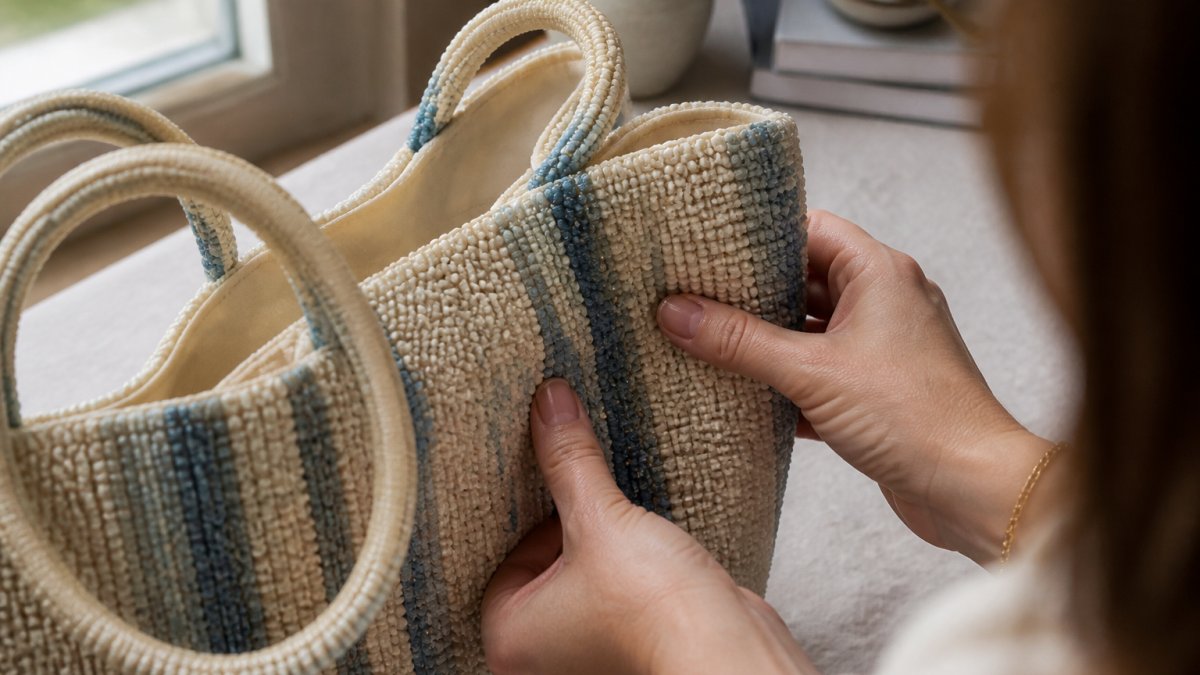
Imperfections are proof of authenticity.
When you verify handcrafted artisan goods, look for slight variations: uneven beads, varying stitch tension, or non-uniform color. These aren't flaws, they're signatures of human creation.
Mass production eliminates variation; machines create identical pieces. Handmade items have character, each slightly different. Our Beaded Mahjong Tote shows this: hand-beading means no two pieces are exactly alike.
Examine the back of the item. Handcrafted goods often show the working process, loose threads, visible knots, less polished areas. Factory items are finished uniformly on all sides.
Check seams and edges for slight variation. Waviness signals hand-stitching; uniform perfection suggests industrial machinery.
Handcrafted items show individual creation: varying stitch tension, subtle color shifts, higher-quality materials, possible maker's mark, weeks or months of production.
Mass-produced goods prioritize speed and uniformity: identical pieces, mechanically perfect stitching, consistent machine-applied colors, cost-driven materials, days or hours of production.
When you compare them side by side, the difference is obvious. The handmade piece has soul; the mass-produced piece feels hollow. Artisan product verification ensures you're buying skill, time, and intention, not just an object.
Ask the maker directly. Good artisans love talking about their craft and answer with enthusiasm and detail.
Ask these questions:
Verify the answers, especially when buying online where you cannot inspect the item yourself.
Research the maker's website, Instagram, and business presence. Look for consistency across platforms: does their story match? Do workspace photos appear in multiple places? Do they post work-in-progress updates? Check how long they've been in business and whether their portfolio shows skill progression. Real makers sound knowledgeable and passionate about their craft, not generic.
Check seller credentials: physical business address, clear contact info, business registration, years in operation, customer reviews, return policies, and transparency about sourcing and production. Legitimate sellers don't hide information; vague or evasive sellers are warning signs.
When you cannot inspect an item in person, use these verification techniques:
Reverse-image search the product photos. Use Google Images or TinEye to search for the listing photos. If the same images appear on multiple seller accounts, multiple marketplaces, or on factory websites, the item is likely dropshipped or mass-produced, not handmade. Legitimate artisans typically photograph their own work and don't reuse images across unrelated sellers.
Examine the photo quality and consistency. Handmade items photographed by the maker often show:
Factory-produced items typically show:
Check the seller's review history and language patterns. Read customer reviews carefully. Do reviewers mention meeting the maker, seeing their workspace, or receiving personalized communication?
Also examine how the seller responds to reviews. Do they engage personally? Do they mention the specific item or the buyer's feedback?
Request process documentation. When you cannot inspect an item in person, ask the seller for:
Legitimate artisans can usually provide at least one of these.
Verify seller history and consistency. Look at the seller's entire catalog, not just one item.
Check how long items stay in stock. Handmade items made-to-order may have longer lead times.
Understand the limits of documentation. Even strong documentation can be staged. Use it as one signal among many, not conclusive proof.
Use this checklist to verify handcrafted artisan goods before you buy. Note that the weight of each signal varies by product category, see the category-specific guidance below.
General signals (apply to all categories):
Category-specific verification cues:
Textiles (woven, sewn, embroidered, hand-printed fabrics):
Ceramics and pottery:
Jewelry (beaded, metalwork, stone-set):
Woodwork and carved items:
Understanding conflicting signals:
Sometimes items show conflicting signals. Weight category-specific signals most heavily. Look for intentionality: did the maker choose a smooth glaze deliberately, or does uniformity seem accidental? Ask the maker directly if unsure.
Red flags that override positive signals:
Watch for these warning signs: seller refuses questions or workspace photos; same item appears on multiple seller accounts; reverse-image search reveals factory photos; seller's story changes; reviews describe identical pieces; price is suspiciously low.
If a claim seems false, take these steps: ask directly for clarification and workspace photos; search for the seller's name and complaints; check if the same item appears on multiple platforms (suggesting dropshipping); compare to verified alternatives; check the return policy; report false claims to the platform.
Buying handcrafted artisan goods is an act of intention. When you verify handcrafted artisan goods with these steps, you protect that investment and ensure your money goes to real artisans, not factories. Our handcrafted pieces come with the confidence that you're buying authentic work.
Genuine handmade products show visible variations, imperfect stitching or beadwork, and inconsistencies that reflect human creation. Check for uneven spacing, slight color variations in materials, and natural wear patterns. Examine the maker's social media, workshop photos, and seller history. Ask the artisan specific questions about their process and tools. Request close-up product photos showing details like stitching, surface texture, and finish. Handcrafted goods from Mercury & Bloom, like the Beaded Mahjong Tote, display intentional artistry with slight variations that confirm handwork.
Ask how long the piece takes to create, what materials they source and why, what tools and techniques they use. For items like the Touchdown Beaded Coin Purse, inquire about the bead sourcing, stitching method, and whether variations between pieces are expected. These answers reveal authentic craftsmanship versus mass production.
Handmade products are created individually or in small batches by artisans using traditional techniques, resulting in natural variations and imperfections. Mass-produced items are manufactured in factories using standardized machinery, creating identical pieces with uniform perfection. Mercury & Bloom's curated collection features handcrafted pieces like the Quilted Floral Tote Bag, where each item's unique hand-block printing and quilting distinguish it from factory-made alternatives.
Check the seller's business registration, physical address, and how long they've been operating. Review customer feedback and ratings, looking for detailed reviews mentioning craftsmanship and authenticity. Visit their social media profiles to see behind-the-scenes content, maker photos, and workshop images. Verify they have consistent branding and professional communication. Look for transparency about their sourcing, production methods, and return policies. Avoid sellers with generic product photos or vague descriptions. Mercury & Bloom provides clear curation standards so buyers know they're supporting real artisans, not dropshippers.


